Session 6: The Glass House
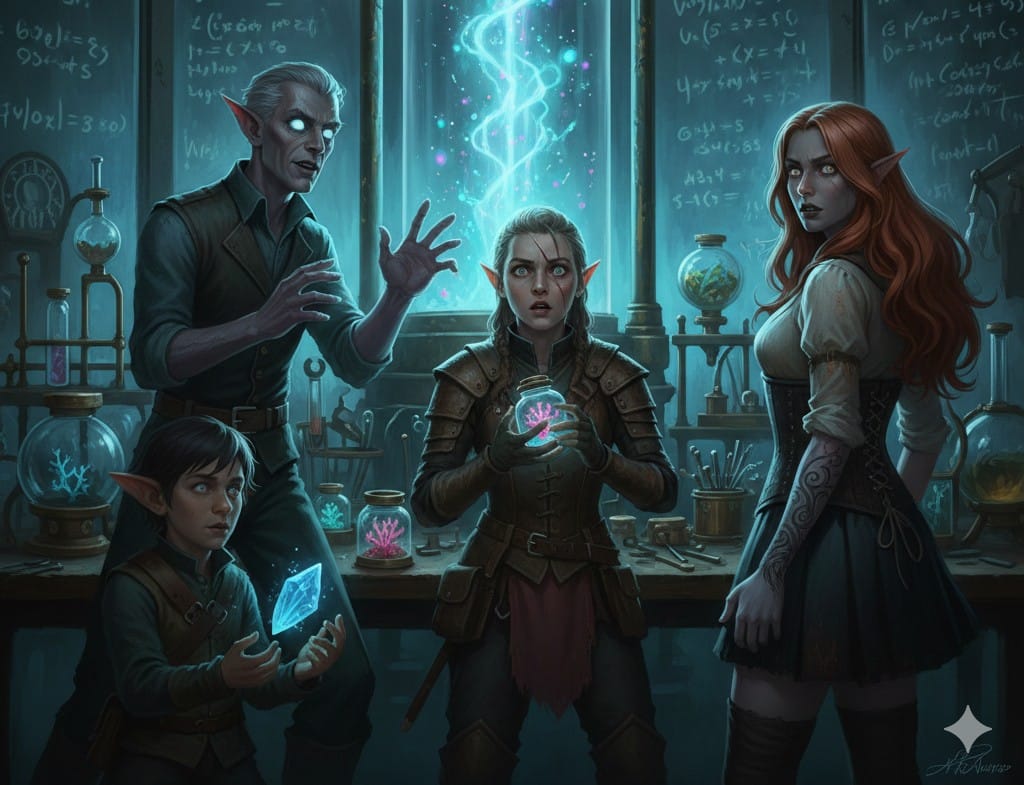
The party stood on the glass beach of Watchtower Cay after vanquishing some random crystal crabs, the lighthouse pulsing its slow blue-white heartbeat above them. Between them and the heavy doors: Project Zero.
The machine was enormous — a patchwork of mining rigs, ship salvage, and early Atlas engineering lashed together into something that had never quite decided what it was. Oszchwald studied it carefully in the predawn dark and rolled a Natural 20 on Perception. What he saw confirmed what his gut already suspected: this was a primitive ancestor of the construct-beast they had barely survived leaving the Atlas docks sessions ago. Hodgepodge. Damaged. Still dangerous.
“AUTHORIZATION. AUTHORIZATION REQUIRED. PRESENT KEY.” The optical sensor swept left, right. Left, right.
Morrigan stepped forward first, drawing the Tropic Star Lines signet ring from her pouch — a trophy from a previous encounter — and presented it with quiet authority. The machine paused. TSL authentication subroutines fired. And then Morrigan rolled a Natural 1.
“TSL AUTHENTICATION. INCOMPLETE PROFILE. OVERRIDE — NO ACCESS. NO ACCESS.”
The sensor blazed red. Threat level elevated. The machine focused on her like a gun finding its sight line. Whatever partial access the ring had once granted, Morrigan’s incomplete profile wasn’t enough to complete the circuit — and the failed attempt had made things worse.
Briony tried next with the same ring, rolling a 16 — a genuine near-success. The machine almost let her through. The party could watch the authentication subroutine light up, stutter, and fail: “INCOMPLETE PROFILE. MANUAL OVERRIDE PENDING.” It was supposed to work. Something in its half-mad programming was stopping it. The machine had not forgotten the previous rejection.
It was Oszchwald who noticed it: the vibration in his pack. He’d been feeling it since they landed — a hum, almost below hearing, coming from the Clarion shard he’d been carrying since they looted an early Atlas operation. The same blue-glowing chunk of raw energy he’d never quite gotten around to using. He quietly slipped away behind the machine’s legs during a sweep of the sensor — Stealth 16, clean — and unwrapped it.
The shard sang. An almost musical tone, harmonizing with something deep in the lighthouse’s foundations.
When he stepped back out and held it up toward the construct’s scanner array, the machine did something that none of them expected.
It hesitated.
“CLARION SIGNATURE DETECTED. RESEARCHER BADGE… OVERRIDE… PROCESSING…”
And then it stepped aside. Sparking. Leaking hydraulic fluid that sizzled on the glass shards underfoot. But it stepped aside.
They walked through the blast doors without firing a single spell.
The Man in the High Tower
The large doors were right there.
Briony suggested they knock.
The party stood outside the outer lighthouse door — still on the glass beach, a sparking construct behind them, a dangerous living island all around them — and debated checking for traps before knocking. Sensibly. Morrigan solved both problems at once, casting Prestidigitation to produce the sound of knocking without anyone having to touch the door.
[The sound echoed through the interior. A pause. Then a click.]
The door opened a fraction. Dark goggles. A harpoon gun, lowered just a fraction. A grey-skinned elf with burns across his hands and white-out eyes squinting into the night.
“Give me one reason not to vaporize you. I’m calibrating.”
Dr. Elias Thorne had been waiting for Atlas, not for a half-drowned group of rogue adventurers. When Morrigan mentioned Sparky Gasket — his former kobold associate from the Drift — the gun came down a little further. When she mentioned the Clarion, the blue stuff, the Salt Rot, the need to fix things — it came down all the way.
Thorne ushered them in, muttering the entire time.
The lighthouse interior was a cathedral made of wrong materials. Blue-white light poured from the Siphon column in the center of the room — a pillar of bioluminescent energy twenty feet tall, slowly rotating, like something alive just barely contained. Glass panels everywhere were covered in grease-pencil equations, arcane notation, and in a few places, what looked like old blood. The smell was ozone, salt, old coffee, and something sharp and chemical underneath everything.
The party explored the lab while he talked at them from different corners of the room. They found specimen jars lining the shelves — coral shards, calcified fish, a human tooth. All labeled in tiny script. All evidence of what Clarion exposure did to living tissue over time.
One jar caught Briony’s eye. A small glass vessel containing what looked like crystallized coral, labeled in faded ink:
Alona — Day 3 — Sample 2
She didn’t ask right away.
Thorne explained the science with the manic clarity of a man who has explained it to himself ten thousand times: Atlas’s drilling had cracked Clarion nodes deep beneath the archipelago. The Salt Rot wasn’t a curse — it was immune response. The island’s Clarion was flooding up through the cracks like scar tissue, irradiating soft flesh as it tried to stabilize itself. The island was eating itself alive because Atlas kept digging the wound open.
His solution — Project Palingenesis — was a defibrillator. A single concentrated pulse of focused Clarion energy, fired downward into the ley lines to reseal them. It could stop the Salt Rot instantly.
It could also kill everyone within 400 miles if he miscalculated.
“Best estimate?” someone asked.
“…50-50. Approximately.”
He said it the way a man says it when the alternative is worse.
The party pressed him on the fuel source. He needed refined Clarion — something he didn’t have. His eyes went to Oszchwald’s shard. “That, in your bag. Yes. Small, but if we run it through the boost array… and a willing spellcaster… I could amplify the output through a living Fey-touched conductor—” He stopped himself, seemingly hearing how that sounded.
But Morrigan had heard the words Fey-touched and filed them away.
You Have Her Eyes
Thorne had been talking for nearly an hour. Then his voice slowed. He looked at Briony — really looked at her — for the first time since he’d lowered the harpoon gun.
“Do I know you?”
Briony asked the question back: “Who do I remind you of?”
The answer came from the shelf. He walked to the specimen jars, the ones she’d already noticed, and lifted one. Small. Labeled. He handed it over.
Alona — Day 3.
“She was the first. One of the first I brought a sample to — before we had a name for it. Before we knew what it did. She was at the docks the day Atlas first breached the Midnight Trench node. The dust from the bloom—” He didn’t finish.
He turned to his desk and pulled a letter from under a stack of charts. Crumpled. Old. Addressed but never sent.
Briony read it aloud, her voice steady only in the way that voices are steady when a person is concentrating very hard on not breaking.
“Rual — I found it. The thing that took Alona from us. It wasn’t just sickness, old friend. It was the dust — the Clarion dust from the first drilling. She was there at the docks when they first breached the node. I can fix it. I can make the water clean again. Tell Little Sprout I’m sorry I left.
— Elias Thorne”
Oszchwald, who had rolled a 1 on Investigation when he tried to study the specimen jar and had privately concluded it looked delicious, sat very quietly.
Morrigan didn’t say anything at all.
Thorne looked at Briony a moment longer. “Little Sprout. Rual’s daughter. You have her eyes. I knew I recognized—” He caught himself again. “You know, he was there when she died. Your father. I don’t think Rual ever recovered from it. I’m not certain I did either. That’s why I’m here.”
Briony asked him to tell her about her mother.
And so he did — Alona, who had come from outer islands whose village no longer existed, who had met Rual on Carpe Diem and used what little innate magic she carried to make flowers bloom. He described her the way someone describes a wound: carefully, with attention to detail, because the details are all that’s left.
“She made flowers bloom,” Thorne said. “Even in salt soil. Even in rocks. It was remarkable.”
The room was very quiet after that.
The Call
And then Briony’s bag vibrated.
She found it in her keepsake pouch — a small whispering conch, the kind she’d carried since childhood. A toy, essentially. A sending stone in the shape of a shell that she and her father used to use to call each other when they were too far apart to shout. She’d kept it because she kept things from before. She hadn’t expected it to work.
It worked.
“Briony? …B? Is that you, love? Oh, thank the— it worked! Craul said it was a long shot but — your brother came back, Bri! He’s an officer now, can you imagine! He found me. He said you were in trouble, that those people you’re with — they blew up the harbor, Bri! The harbor! Craul said we had to come get you before— we’re here to rescue you, love. We’re just off the lighthouse now. Atlas lads are very professional. Very above-board. You’re safe now.”
Her father. Rual Shard. Drunk, stumbling over his words, the way he’d always been when emotion got the better of him. Genuinely relieved. Genuinely happy. Completely convinced he was doing the right thing.
He had no idea he was being used.
Briony rolled Insight and the result was a high enough number that she recognized the voice without doubt — but not high enough to feel anything uncomplicated about it. She’d told herself he was dead years ago. It was easier than accepting he had simply left.
Every alarm panel in the lighthouse lit up red.
PROXIMITY ALERT. ATLAS FLOTILLA DETECTED. VESSEL COUNT: 4. FLAGGED: GILDED HOOK (ATLAS COMMAND).
Thorne spun from his workbench. His hands flew across the security console — “Glyphs unresponsive. Arcane lock bypassed. External override detected: TSL Authority Seal.” Everything he’d built to protect himself. Gone in a moment, overridden by a signal from a ring just like the one Morrigan had been carrying.
The Gilded Hook
Through the lighthouse glass, searchlights. Four ships moving in slow formation. The Atlas flagship, The Gilded Hook, launched a signal flare that blossomed against the storm clouds in the shape of an anchor — the Atlas crest, skywritten in golden light against the bruised dark.
Beautiful and horrible.
The broadcast came next, amplified through ship crystals until it vibrated in the glass walls:
“Dr. Thorne. This is Captain Valerius of the Gilded Hook, operating under Atlas Group Charter and the Merchant Authority of Isla Prima. We are here pursuant to a formal Search and Recovery request filed by Mr. Rual Shard regarding his daughter, believed to be held against her will. You have ten minutes to open the blast doors and surrender the individuals in question. Failure to comply will be treated as obstruction of a lawful recovery action.”
Not a threat. A legal notice. Corporate language designed to sound unchallengeable. It doesn’t threaten violence. It implies it.
And then — a pause. A different voice. Quieter. More intimate.
“It’s me, Bri. I know you’re in there. I know you’re scared. Just open the door. Dad’s right here. Nobody has to get hurt. …Don’t make me hurt you again.”
The last sentence delivered gently. Like a promise, not a warning.
Craul Shard. Her brother. Making his first real appearance in the story not as an enemy, not as a villain, but as a voice that sounded like family. That was the horror of it.
Briony tried to respond — to warn him off, to tell him the island wasn’t safe, to appeal to something still alive in him. She rolled Intimidation: 11. Craul, his voice smooth as still water, was not impressed. He didn’t sound afraid. He sounded like someone who had already made all the decisions that mattered.
“The power is shifting,” he said. “I’ve chosen my side. You’re welcome to come along.”
“You don’t really have much choice here, Bri. Not anymore.”
Thorne, watching the conch and watching the incoming sensors and watching all of it happening at once, made a decision. He grabbed the conch from Briony’s hand and slammed it on the ground.
Porcelain and shell-dust scattered across the flagstone. Her last connection to her father. Gone.
“They were tracking you through it,” Thorne said, not unkindly. “It was how they found you.”
Nobody had a response to that.
The Moral Knot
For a few feverish minutes, the options laid themselves out:
Surrender. The Consortium gets them. The Siphon Core falls into Atlas hands. Rual gets to watch his daughter dragged onto the Gilded Hook. Craul wins.
Fight the boarding party. Four ships. Thirty Atlas soldiers minimum. They’re buying seconds, not victory.
Fire the Pulse. 50-50 odds. If it works: Atlas’s drilling machinery jams globally, the Salt Rot halts. If it fails: everyone within 400 miles dies. The Neb is anchored 200 yards from the island. Zyla and Captain Moray are out there. Every choice in the session had circled around the Pulse, and now it was right there — available, loaded, waiting — and nobody pulled the trigger. Not even Oszchwald, who had been tempted.
Escape. The only real option. But it had to be now.
Thorne, who had been very quiet while they argued, detached something from the Siphon column. A canister roughly the size of a football, glowing soft blue, warm to the touch, pulsing faintly with something that felt disturbingly like a heartbeat. The Siphon began to dim around it, like a hearth going cold.
“They want the Siphon? Fine. They can have a very expensive paperweight. They don’t get the Core. They don’t get the formula. They don’t get the variables.”
He tossed it to Oszchwald, who caught it on reflex.
“If they get this, they will weaponize the Rot. They won’t cure it — they’ll bottle it. If I get it somewhere safe and rebuild… maybe. Maybe I can still fix this. So go. Take it. Go now.”
Nobody asked him to come with them. He wasn’t going to. They could tell.
Through the Moon Pool
The exit was in the basement: a moon pool, the water black and cold and leading somewhere else. Thorne had a prototype submersible — a riveted brass egg with a porthole the size of a dinner plate and a hand pump for ballast. It smelled like brine and machine oil. It barely worked. Nobody got in it.
They went in the water.
Briony used her last Wild Shape to become a giant octopus. Eight arms, four-foot body, and the kind of hydrodynamic efficiency that makes walls of water irrelevant. Oszchwald grabbed a tentacle. Morrigan grabbed another. They went under together.
The Dice Don’t Care About Your Plan
The escape had three phases, run as a skill challenge over a dark underwater tunnel. Two successes before two failures.
Round One: Briony was fine — rolling 14 on a Nature Check with advantage, the octopus body doing what octopus bodies do. Oszchwald held on, managing a 10 on Constitution save — just barely succeeding. Morrigan rolled a 6. First failure. She started to panic.
Round Two: Briony rolled 20+ — gliding through the dark water like she was born to it. Morrigan rolled a 1 on her Constitution save. She lost her grip on the tentacle entirely. Somewhere in the dark tunnel, she fell away from Briony, suspended in black water, lungs burning, the exit nowhere in sight.
With no other options, she tried to cast Misty Step — she could see Briony’s shape ahead, luminous and enormous in the dark. Thirty feet. She just needed to say the words.
And choked on the water.
Constitution save to get the words out: 5.
The spell fizzled. Morrigan inhaled saltwater. She was suffocating. She had two minutes before she would lose consciousness and begin dying.
Oszchwald rolled 4 total on his Constitution save. He was panicking, out of breath, and the tunnel had no air pockets worth using, just small desperate bubbles at the top of the rock.
One failure. One success. Oz was teetering.
Round Three: Briony, in full octopus mode, feeling the tunnel current and the location of her companions through eight sets of suckers pressed against the rock — turned around. Found Morrigan. Grabbed her. Briony rolled 19 + 5, and that was enough. She hauled them both through the last passage and broke the surface gasping, all three of them colliding with salt air and starlight a hundred yards off the island’s blind coast.
Morrigan had been near unconsciousness.
She did not mention this to the others.
The Lighthouse Burns Gold
They surfaced in open water, the Neb’s lights a quarter-mile distant. The island behind them was chaos — lightning arcing from the lighthouse windows, blue-white energy pulsing and flaring in ways that suggested someone inside had thrown every remaining circuit into maximum discharge.
Thorne, buying them time. Thorne’s way out.
Briony shifted back to herself, treading water, and they pulled toward the rowboat the Neb had sent to meet them at the pre-arranged coordinates. Above them, the lighthouse pulsed white once, intensely — and then the blue light faded.
When it came back, it was gold.
Atlas gold. The Gilded Hook’s colors. The lighthouse’s Siphon, now powerless, lit by standard torches and lanterns as Atlas soldiers moved through the lab. On the island, the battle was over. It had never really been a battle.
Captain Moray leaned over the Neb’s railing as they came aboard, salt-soaked and still catching their breath.
“The Drift is a long night sail from here,” she said, voice low. “Get some sleep. Or don’t.” She looked at the soft blue pulse leaking through Oszchwald’s pack where the Siphon Core was poorly wrapped. “But keep that thing covered. If the light leaks through the hull and they’ve got crystal eyes on the water—”
She didn’t finish the sentence. She didn’t need to.
Below the deck, muffled through the dark water of memory, Briony thought she could still hear it — her father’s voice on the conch, confused, still calling her name through the static as the connection died on the lighthouse floor.
“Briony? …Where did you go? …Bri?”
She didn’t answer. The Neb came about, sails dark and full, and made for the Drift.