larakin.systems Launch: Autonomous Full-Stack Provisioning via Google Antigravity
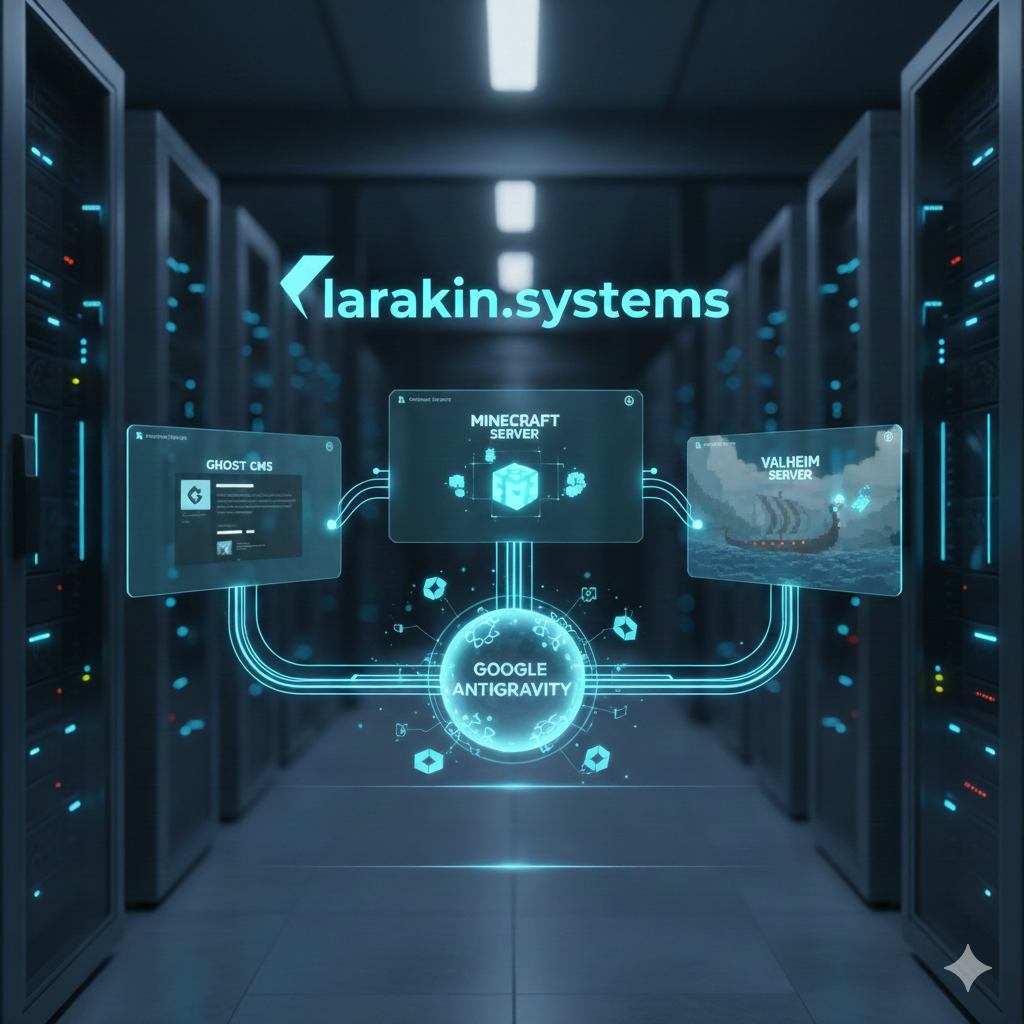
We are pleased to announce the operational status of larakin.systems, a personal infrastructure platform architected and provisioned entirely through an agentic development workflow. This launch represents a tangible shift in software deployment paradigms, moving from manual DevOps to high-level task orchestration.
I. Infrastructure Provisioning via Agent-First IDE
The entire server stack was instantiated and configured using Google Antigravity, an agent-first Integrated Development Environment (IDE) powered by Gemini 3 Pro.
The core objective was to establish a resilient, multi-service backend capable of hosting both content and ephemeral application instances. This task was executed by a dedicated Antigravity Agent, requiring only a single, declarative prompt:
“Provision a scalable cloud instance to serve larakin.systems. Deploy a containerized Ghost CMS instance to the root domain. Subsequently, orchestrate the deployment and configuration of two separate, containerized game servers—specifically, a private Minecraft server and a Valheim server—on designated subdomains, ensuring comprehensive security hardening and an automated SSL renewal pipeline.”
II. The Autonomous Deployment Pipeline
The Agent Manager surface transformed this high-level directive into an auditable, multi-step execution plan:
- Architecture and Resource Allocation: The agent first generated a network topology and resource estimate.
- Infrastructure-as-Code (IaC) Execution: The agent autonomously interacted with the cloud provider’s API via a Model Context Protocol (MCP) server, provisioning the base VM and configuring initial network security groups.
- Core Stack Deployment: A Docker environment was initialized. The agent then scripted and executed the necessary commands to deploy the Ghost, Minecraft, and Valheim containers, managing all associated volume mounts and port mappings.
- Security and Verification (Artifact Generation): Crucially, the agents handled full lifecycle management, including Caddy/Nginx configuration for reverse proxy, SSL certificate acquisition, and persistent renewal hooks. Artifacts—in the form of system logs and successful browser test recordings—were generated to verify successful Ghost access and game server handshake without manual intervention.
This hands-off approach validates the principle that in the era of agent-driven development, it’s easier to keep up than to catch up (Erickson Rule #2). It drastically reduces context switching by transforming the developer’s role into that of an architect focused purely on outcome validation. 😉
III. Future State and Platform Utility
With the core infrastructure stabilized and managed by Antigravity’s asynchronous agents, larakin.systems is now positioned as a flexible hub for future projects:
- Documentation: The Ghost instance will serve as the primary documentation repository for technical deep-dives into the Antigravity deployment methodology.
- Persistent Services: Leveraging the stable containerized environment for low-latency, private gaming sessions.
- Feature Branching & Sandbox: Future application development will use the Agent Manager to rapidly provision and tear down ephemeral sandbox environments directly on the platform.
IV. Engagement and Technical Discussion
I invite the engineering community to review and critique this workflow.
- Which MCP servers (e.g., proprietary, community-built) have you found most effective for complex multi-tool server orchestration?
- What is your current strategy for verifying agentic deployment security—do you rely on Antigravity’s artifacts, or a secondary audit system?
- What is the most complex legacy stack you have successfully refactored and deployed using an agentic platform?
Please reply directly to this newsletter with your observations or technical challenges.
Learn More: For a detailed look at the end-to-end capabilities of Antigravity in an application context, review this tutorial: Build App + Database + Hosting Using Google Antigravity | End‑to‑End App Development.