Building a Second Brain for Dungeon Masters: How AI Transformed My Campaign Organization
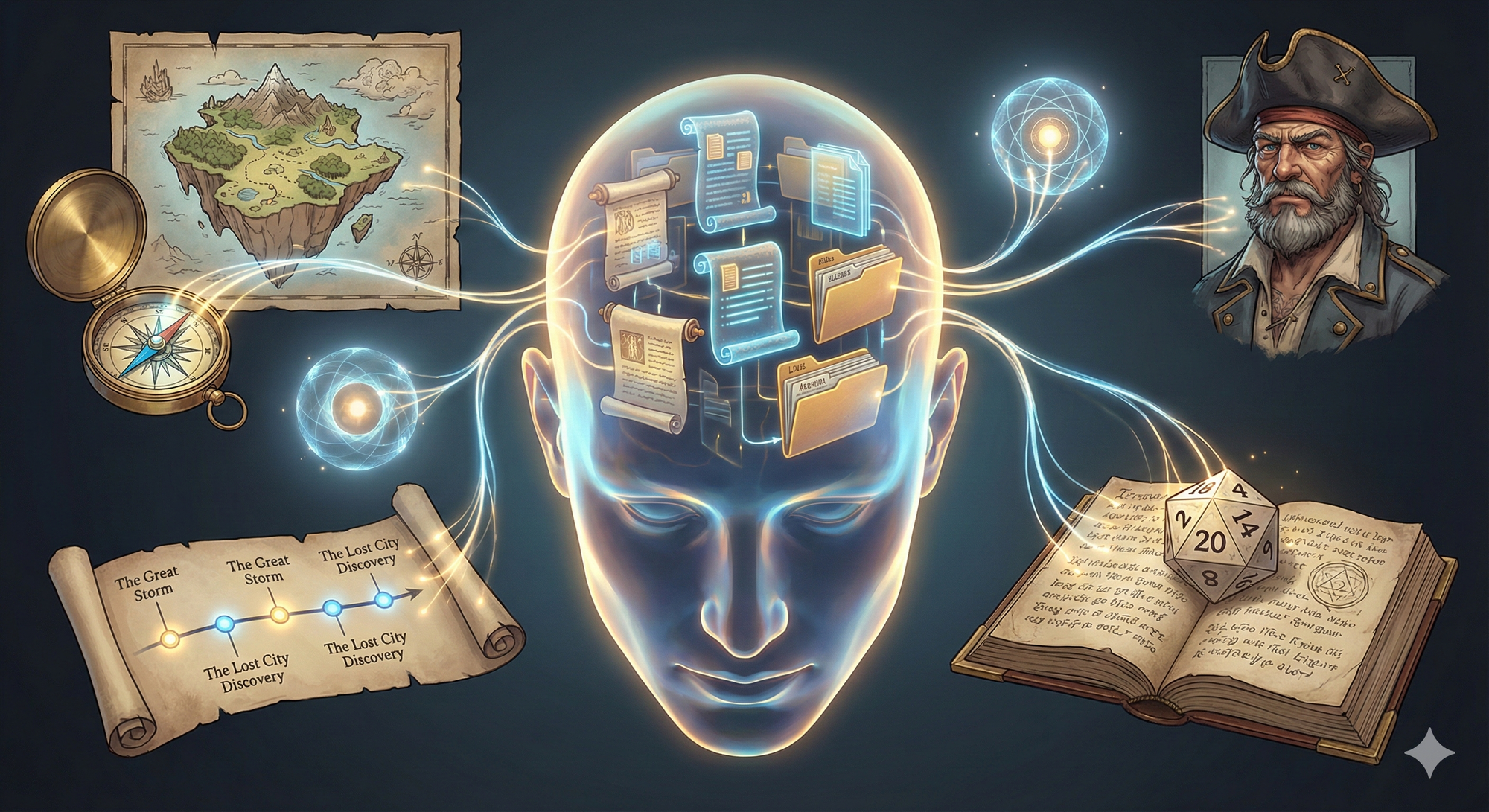
Every Dungeon Master knows the feeling: sticky notes everywhere, half-written NPCs in various notebooks, location details scattered across Google Docs, and that nagging certainty that you wrote down something important about the merchant’s backstory… *somewhere*. Running a D&D campaign is an exercise in creative chaos management, and for years, I struggled to find a system that could keep up with the pace of collaborative storytelling.
Then something changed. Not through programming or complex software development, but through a partnership I never expected: working with an AI assistant in a structured file system to build a “second brain” for my campaign.
This is the story of how I created the **Island Campaign Repository**—a living, breathing digital nervous system for my D&D world—and discovered that you don’t need to be a programmer to harness the organizational power of AI.
The Genesis: From Chaos to Structure
The Problem: Before this system, my campaign prep looked like this: session notes in physical notebooks, NPC details in random text files, world lore half-remembered from Discord conversations, no clear distinction between “what I planned” and “what actually happened,” and preparation each week meant frantically searching through all of this.
The traditional solutions—wikis, campaign management apps, sprawling OneNote documents—all felt either too rigid or too freeform. I needed something that could grow organically with my campaign while maintaining structure.
The Solution: The breakthrough came when I realized that simple markdown files in a thoughtfully organized directory structure could serve as my campaign’s foundation. Not in some proprietary app that might disappear, but in plain text files that would last forever and work everywhere.
Here’s the structure I developed:
```Island Campaign/├── 00-Sessions/ # The actual history of play├── 01-Characters/ # NPCs and PC backstories├── 02-Locations/ # Cities, ships, POIs├── 03-Lore/ # Factions, deities, history├── 04-Mechanics/ # House rules and homebrew├── 05-Story/ # Arcs and subplots├── 06-Maps/ # Visual references└── 99-Templates/ # Reusable templates```
Simple, right? But the magic isn’t in the folders—it’s in what happens *inside* them and how AI helps me maintain and leverage this system.
The Role of AI: A Creative Partner, Not a Coder’s Tool
Here’s the revolutionary part: I didn’t write a single line of code to build this system. Instead, I worked with Antigravity (Google’s advanced AI assistant) as a creative collaborator, knowledge manager, and organizational partner.
What AI Actually Does for Me
Intelligent Content Creation: When I need to develop an NPC, I don’t stare at a blank page anymore. I have conversational brainstorming sessions where I might say “I need to flesh out Zyla Vane, the Bosun. I’m thinking he has a ‘head secretary at Mad Men’ type vibe,” and the AI provides detailed personality traits, speaking patterns, motivations, and suggests how his character can create interesting tensions aboard ship.
The AI doesn’t just give me generic content—it understands the context of my entire campaign because it can read all my files. It knows about the Lucayan Archipelago, the Salt Rot plague, the Atlas Group, and every session that’s happened. It provides suggestions that *fit*.
Canon Tracking and Continuity Management: One of my biggest innovations (with AI’s help) was creating a Canon Archival System with three tiers: CANON files (what actually happened in play), PREP files (what I planned), and ARCHIVED files (planned but didn’t happen).
After each session, I work with the AI to review what content was used, partially used, or ignored, move unused prep to the Archive folder, update NPCs and locations with `canon: true` if they appeared, and ensure future planning only references truly canonical information. This prevents “DM continuity errors” where I accidentally reference something that never actually happened in the game.
Session Analysis and Insights: After Session 1, I asked the AI to analyze dice roll statistics from my session notes. Within moments, I had lucky/unlucky roll patterns for each character, identification of dramatic moments, and suggestions for how to play into these patterns narratively. The AI reviewed my session transcript and identified storytelling opportunities I’d missed in the heat of play.
Worldbuilding Consistency: When I got confused about my own geography (Was Watchtower Cay the same as Whispering Deep? What’s the difference between an Isla and an Island?), the AI reviewed all my location files, identified the inconsistencies, helped me establish clear definitions, and updated documentation across multiple files.
Creative Problem Solving: I had a custom d20 with two faces showing ‘20’ and two showing ‘1’ (high variance). I asked the AI to brainstorm “fun uses” for this mechanic. The conversation led to the High Variance Oracle—a dramatic divination mechanic that’s now a staple of my campaign.
The Development Process: Iteration Through Conversation
Building this system wasn’t a single design session. It evolved through dozens of conversations over weeks: Initial Structure (“Help me organize my campaign files”), Template Creation (“I need reusable templates for NPCs and sessions”), Canon System (“How do I track what actually happened vs. what I planned?”), ongoing Content Development for NPCs, locations and lore, Session Support with pre-session prep and post-session analysis, and Meta-organization for blog posts, plot summaries, and arc tracking.
Each conversation built on the previous ones. The AI remembered context, maintained consistency, and helped me refine the system through actual use.
The Benefits: Beyond Organization
Session Preparation transformed from 2-3 hours of frantic prep, searching through notes, hoping I remembered everything, to 30-minute focused sessions where I ask AI to “Review the last session and suggest plot hooks,” “What are three ways to integrate Thorne’s backstory into Session 2?” or “Help me develop the Atlas Group presence at Whispering Deep Outpost.” The AI instantly references all relevant lore, characters, and previous sessions. Prep is now *creative* instead of administrative.
Improvisation Support means when players do something unexpected (they always do), I can quickly consult my files. Everything is in one place, searchable, and cross-referenced. The AI has helped me build internal links between related content.
Long-Term Continuity: Six months from now, when a player asks “Didn’t we meet a merchant in Session 2 who mentioned something about his sister?”, I’ll have complete session transcripts, tagged character mentions, a searchable knowledge base, and AI assistance to quickly find and summarize relevant information.
Player Engagement: I’ve started creating Episode summaries (narrative blog posts from session notes), campaign recaps for players who missed sessions, lore documents players can reference, and character spotlight posts celebrating player moments. All of this would be overwhelming to create manually. With AI partnership, it takes minutes.
The Philosophy: Augmentation, Not Automation
The key insight: AI isn’t replacing my creativity—it’s amplifying it. I still make all creative decisions. I still design the encounters, voice the NPCs, and guide the story. But I’ve offloaded the organizational burden, the cross-referencing work, the “wait, what did I call that place?” moments.
The AI is my research assistant (finding information in my own notes), continuity editor (catching inconsistencies), brainstorming partner (offering ideas I can accept or reject), documentation specialist (formatting, organizing, linking), and memory palace (perfect recall of everything in the system).
You Don’t Need to Program: This is crucial. I write markdown files. I have conversations with an AI. I organize folders. The “technical” work—tracking files, maintaining consistency, generating structured content—happens through natural language conversation. I describe what I want, and the AI helps me build it.
This is what makes the Antigravity environment revolutionary for creative work. The power of structured data, version control, and interconnected knowledge… without needing to learn to code.
Practical Tips for Building Your Own System
If you’re a DM (or any creative organizer) inspired to try this:
Start Simple: Begin with basic folders: Sessions/, Characters/, Locations/. Don’t over-engineer. Let the system grow organically.
Use Plain Text: Markdown files are future-proof, searchable, compatible with everything, version-controllable (use Git if you want), and human-readable.
Develop Templates: Create reusable structures for NPC profiles, session notes, and location descriptions. This makes creation faster and maintains consistency.
Embrace Conversation: Don’t just command the AI—*collaborate* with it. Ask for alternatives, request analysis, seek connections you might have missed, and let it challenge your assumptions.
Build Over Time: My system emerged through actual use. Each session revealed new needs. Each conversation refined the structure. Don’t expect perfection on day one.
Distinguish Canon from Prep: This was my breakthrough insight. Track what you planned (prep files), what actually happened (canon files), and what was abandoned (archived). This prevents future sessions from contradicting reality.
Real-World Example: The NPC Development Workflow
Let me show you how this works in practice with Captain Morena Moray:
Step 1: I tell the AI “I need a ship captain who’s unknowingly smuggling for the Atlas Group.”
Step 2: AI creates `Captain_Morena_Moray.md` using the NPC template, populated with initial ideas.
Step 3: I refine: “I want her to be a strong female captain who’s selectively ignorant about what she’s transporting to maintain independence.” AI updates the file with detailed personality traits, motivations, and relationship dynamics.
Step 4: AI suggests how she connects to the ship file, Atlas Group lore, and upcoming Session 2 prep.
Step 5: During the game, I reference her file. After the session, I add canonical markers like `first_appearance: session_01` and document that players negotiated passage and Oszchwald stole from her bosun.
Step 6: The AI now knows Captain Moray is CANON and can reference her appropriately in future session prep.
**Total time:** 15 minutes. **Result:** A fully-developed, campaign-integrated NPC with documented history.
The Unexpected Benefits
Beyond organization, this system has given me:
Creative Confidence: I can try ambitious narrative arcs because I trust my system to maintain continuity.
Reduced Anxiety: No more Sunday night panic. Prep is manageable and even enjoyable.
Deeper Engagement: I can analyze patterns (successful dice rolls, player preferences, recurring themes) to improve my DMing.
Player Artifacts: Session recaps, character blogs, and lore documents make players feel more invested in the world.
Personal Documentation: I’m creating an artifact of our shared creative experience that will last beyond the campaign.
The Future: Living Systems
This isn’t a static tool—it’s a living system that grows with my campaign.
I’m currently exploring voice-to-text session transcription, AI-generated session summaries, visual maps with linked location data, player-facing wiki exports, and Discord bot integration for quick lore lookups. All of this without writing code—just conversations about what I want, with an AI partner that helps me build it.
Conclusion: The New Creative Partnership
The Antigravity environment represents something profound: the democratization of structured knowledge management.
You don’t need to be a programmer to build sophisticated systems anymore. You need a clear goal (run a better campaign), a willingness to organize (folders and files), and an AI partner (for the heavy lifting).
This partnership—human creativity and AI capability—is transforming what’s possible for creators, organizers, and storytellers.
My D&D campaign is better organized than my actual life. My players get detailed recaps, rich lore, and consistent worldbuilding. I spend less time searching and more time creating.
And I didn’t write a single line of code.
That’s the power of AI in the Antigravity environment: Making sophisticated tools accessible to anyone with ideas and the will to organize them.
Whether you’re running a D&D campaign, writing a novel, managing a project, or building any kind of complex creative work—this approach scales. Files, folders, conversations, and iteration.
The future of creative work isn’t about replacing human creativity with AI. It’s about partnerships where AI handles the structured work while humans focus on imagination, emotion, and meaning.
I’ve found my perfect DM assistant. It never gets tired, never forgets, and always helps me be better prepared to tell amazing stories with my players.
And you can too.
About This System
The Island Campaign Repository is my personal D&D campaign management system, built through collaborative work with Antigravity AI. It uses plain markdown files for all content, directory organization for logical structure, Git version control for history tracking, templates for consistency, a canon archival system for continuity, and AI partnership for content creation and analysis.
Time to build: Evolved over 2-3 weeks of active campaign play
Technical skills required: Ability to create folders and text files
Lines of code written: 0
Creative control maintained: 100%
If you’d like to see the system in action or discuss how to adapt this approach for your own creative projects, feel free to reach out. The revolution in personal knowledge management isn’t coming—it’s here, and it’s accessible to everyone.
Happy gaming, and may your campaigns always stay organized!*